

Some People Hear a Voice. I Hear the Details.
Most people listening to a voiceover will never think about the studio behind it. They often do not even realise they are listening to a person. They see a product, watch a video or simply follow a story.
And when a voiceover is done well, it should not dominate the production. It should guide the listener gently towards what they need to know.
Most people also never think about the equipment used during the recording session. And that is exactly how it should be. They should not be wondering which microphone, audio interface or signal chain was used. They should simply hear a voice that feels clear, warm and trustworthy.
Behind sound that seems effortless, there is a lot of care.
Recently, I made a very exciting upgrade in my recording studio. After ten very happy years with my Focusrite Scarlett 6i6, I purchased the Apollo Twin X audio interface. Not because the Focusrite did not do its job, it absolutely did. It has been part of many recordings I am proud of.
For me, this upgrade is not about having a shiny new piece of equipment on the desk. It is about sending audio that does not slow down the production process, but helps it move forward.
With my Neumann TLM 103, the Apollo Twin X helps me record voiceovers with more depth, clarity and control. The recording helps the editor to have to fix less in post production, which means the voice can sit beautifully in a commercial, online ad, social video, brand film or e-learning project.
And that is where it matters for the client.
A commercial should not sound like the voice was added at the last moment. An online ad should be clear without feeling sharp or tiring. A brand video needs warmth and confidence. E-learning should stay pleasant to listen to, even when the content is longer.
The better the recording is at the source, the more naturally it supports the final production. Some producers require a ‘signal’ or recording, as clean as possible, so that they can add any plugins when needed on their end, in post production.
For some projects, a bit of extra warmth or character is needed in the recording. In that case, I can use my SSL XLogic channel, as well as professional plugins through the Apollo Twin X, to shape the sound in a way that fits the project.
The clever thing about the Apollo is that it is almost like a small computer in itself. It does not just record the sound. It also has its own built-in power to run professional audio plugins. That means I can hear my voice with plugins on my headphones whilst recording a clean signal, or record them with the sound of the plugins, without asking my computer to do all the heavy processing.
That flexibility is important, because not every project needs the same sound.
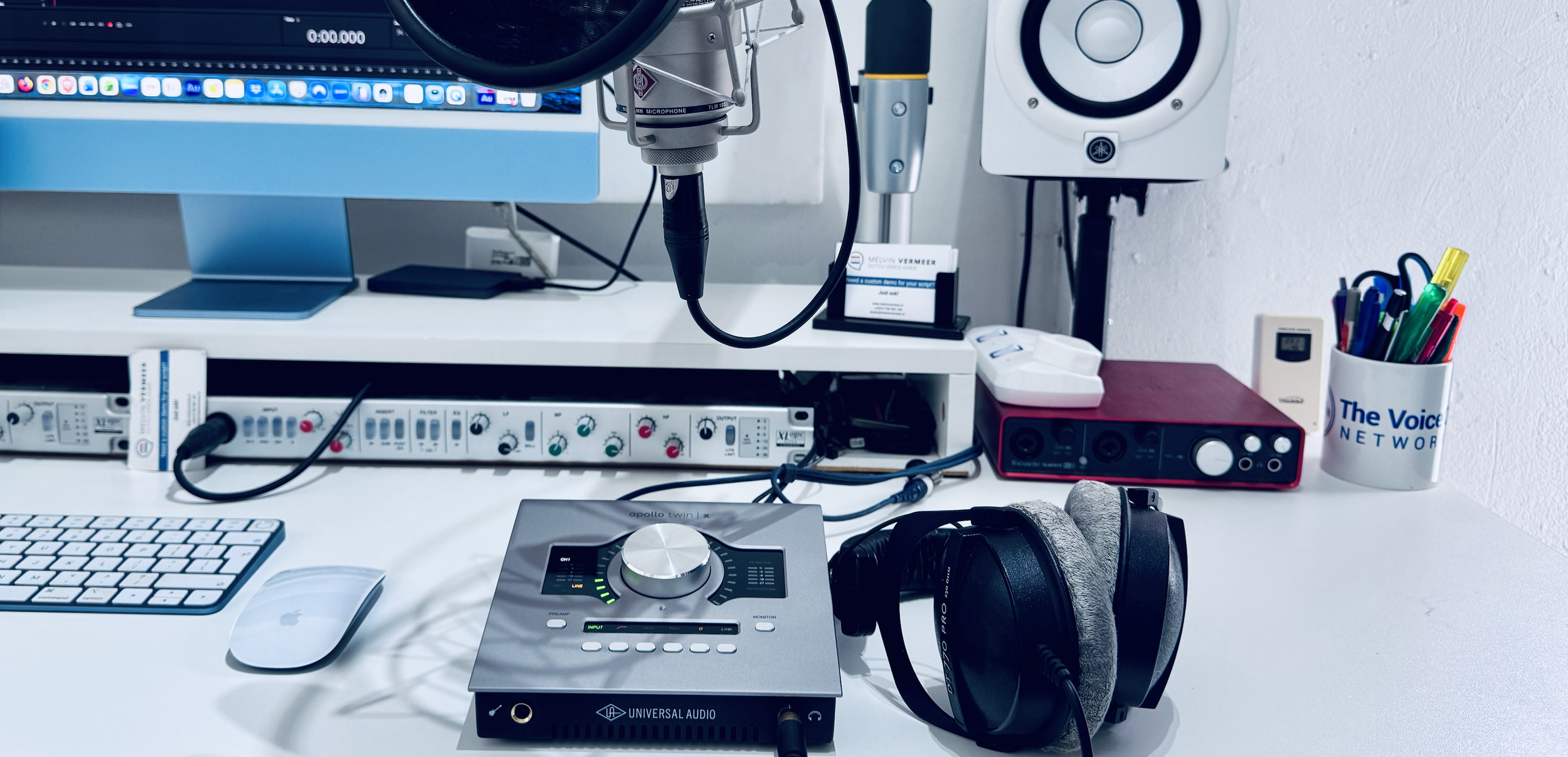
Apollo Twin X by Universal Audio
With everything happening around AI voiceover, I understand why many people in the voiceover industry are thinking carefully about the future. The landscape is constantly evolving. But for me, investing in my studio still feels like the right move.
I do not see this as a race against AI, and I am not building my business from a place of fear. I see it more like this: when a client chooses to work with me, I want to give them the best possible experience in performance, communication, reliability and sound quality.
As I have mentioned in other blogs, I believe strong business relationships are built on trust. And trust grows when people feel that you care about their project and the quality of what you deliver.
The focus is, and always will be, on delivering a service.
When a client books me, I want them to feel they are getting more than a voice. They are getting experience, attention, interpretation, quality and a studio that is built to help their message land in the best possible way.
So by investing in a high-end audio interface, the truly amazing Apollo Twin X, I invested in the next level of my service.
Because your message matters, and I love being here to help create it, shape it and voice it for you.